Research-use-only guide. It explains what tesamorelin is and how to evaluate supplier documentation. It does not give dosing, protocols or medical guidance. Supplier links are affiliate links; see below.
The odd one out in this directory
Most of the compounds on this site share a similar backstory: a few academic papers, a lot of internet enthusiasm, and no regulatory approval anywhere. Tesamorelin breaks the pattern. A pharmaceutical version of it was developed by a mainstream drug company, tested in randomized placebo-controlled trials involving hundreds of people, and approved by the US Food and Drug Administration in 2010 for a specific condition: excess abdominal fat in adults with HIV who have lipodystrophy. It is a prescription medicine, sold under a brand name, made under pharmaceutical controls.
That history is useful context and a trap at the same time. It is useful because it means tesamorelin has far better human evidence than most research peptides: published trial data, a regulatory review, and a documented safety profile for that one indication. It is a trap because none of that transfers to a vial of research-grade powder from a website. The trial data belongs to the drug product, made by a regulated manufacturer, formulated and tested to pharmaceutical standards. A laboratory-supply vial is a different product with different provenance, and this site offers no guidance on using one. If you want a more detailed background piece, our tesamorelin research guide covers the pharmacology in more depth.
What kind of molecule it is
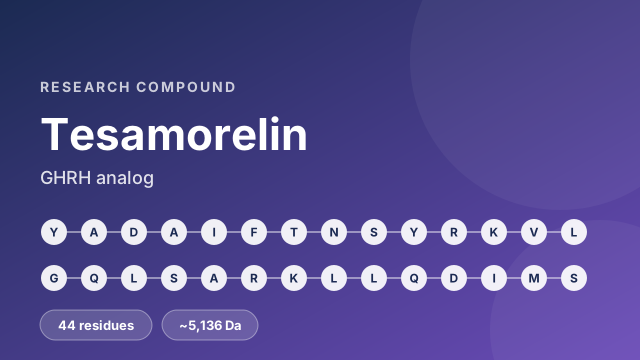
Tesamorelin is a modified version of growth hormone-releasing hormone, the hypothalamic peptide that tells the pituitary gland to release growth hormone. Natural GHRH is 44 amino acids long and is rapidly broken down in the body, with a half-life measured in minutes. Tesamorelin keeps all 44 residues but adds a small chemical cap to the front end: a trans-3-hexenoyl group attached to the first amino acid, tyrosine. That cap protects the molecule from a particular enzyme that would otherwise chop off the start of the chain, extending its useful life considerably. The mass of the whole thing comes to about 5,136 daltons.
For comparison, ipamorelin is a five-residue peptide of around 712 daltons, and BPC-157 is a fifteen-residue peptide of around 1,419. Tesamorelin is roughly four times the size of BPC-157. That size is the root of most of the quality issues described next.
Why length makes quality harder
Solid-phase peptide synthesis builds a chain one amino acid at a time. Each coupling step works almost perfectly, but never exactly perfectly. Suppose each step succeeds 99.5% of the time. Over 5 steps, nearly all the product is intact. Over 44 steps, around a fifth of the chains will have at least one defect, and the arithmetic worsens if any step is more difficult than average. The usual defects are deletion sequences, where one residue is missing, and truncations, where the chain stopped early. These impurities are chemically very close to the target, so they emerge from a chromatography column almost on top of the main peak.
The practical consequence is that a purity figure for a 44-mer means something quite different from the same figure for a tripeptide. A reported 98% on a short peptide can reasonably be believed. On a long peptide, the same figure depends heavily on how the integration was done, how long the gradient was, and whether the method can really separate neighbours. Ask for the chromatogram, and look at the shoulder of the main peak with some suspicion. The expected mass, around 5,136 for the modified peptide, should appear in the spectrum, and a report that gives a mass in the right region but cannot show how the hexenoyl cap was confirmed leaves a question open.
Checking the modification
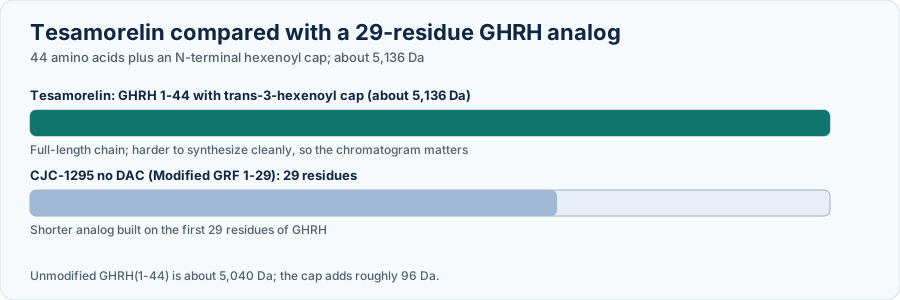
The cap is what distinguishes tesamorelin from unmodified GHRH(1-44), which weighs about 5,040 daltons without it. Hexenoyl adds roughly 96 daltons. A mass spectrum should therefore sit near 5,136 and not near 5,040. This is a simple and powerful check, and the one most worth asking about. A COA that reports only "purity 99%" with no mass is not evidence of identity at all. A COA that shows a mass consistent with unmodified GHRH is describing a different molecule.
| Expected mass | About 5,136 Da for tesamorelin; about 5,040 Da for unmodified GHRH(1-44). |
|---|---|
| Chromatogram | Full trace with a visible baseline. A long-gradient method is better than a short one for a 44-mer. |
| Counter-ion | Acetate is typical; some suppliers use trifluoroacetate. Net peptide content differs. |
| Batch details | Lot, date, laboratory name, and a fill amount that matches the vial label. |
| Sterility or endotoxin | Usually not tested on research-grade product. Be wary of suppliers implying otherwise. |
How it differs from its neighbours
Tesamorelin is often discussed alongside CJC-1295 and ipamorelin, but they are three different things. CJC-1295 without DAC is a 29-residue GHRH analogue, much shorter than tesamorelin and with multiple amino acid substitutions; see our CJC-1295 guide. Ipamorelin is not a GHRH analogue at all but a ghrelin-receptor agonist built on a completely different principle; see ipamorelin. Listings that blur those distinctions are worth reading carefully, because the molecules differ in size, in synthesis difficulty and in price, and a supplier that confuses them is telling you something about its quality control.
Storage and shipping questions
Long peptides tend to be more fragile than short ones. They have more places to oxidise, more bonds that can hydrolyse, and a greater tendency to aggregate if they are handled badly. Freeze-dried powder protects against most of this, which is why it is the standard form, but a batch that has spent weeks in a warm warehouse is not equivalent to one stored cold. A supplier that states storage conditions, gives manufacturing or testing dates, and describes how orders are packed is giving you the information you need to judge this. One that offers none leaves the question open. This is a good reason to prefer suppliers whose policies you can actually read, and to look at refund and replacement terms before you order. A higher price from a supplier with traceable batches can be a better value than a bargain with no paper trail, particularly for a molecule as demanding to make as this one.
Where to find it
Three suppliers in our directory list tesamorelin. I have not ordered from them; the notes below come from their public listings. Please check each batch's documentation before relying on any of them.
Iron Peptides lists a 10 mg tesamorelin vial, and code IRONMAN takes 10% off. We reviewed the company in detail in our Iron Peptides review; it also holds a sponsored placement on this site.
Next Gen Peps lists tesamorelin among its research peptides. See our Next Gen Peps review.
Vortex Research lists tesamorelin as a single-compound vial, with the PEPPERS code advertised at 30% off. We have not reviewed this supplier yet.
All three are affiliate links. PeptideSuppliers.org may earn a commission if you buy through them, at no additional cost to you. Our ratings and the alphabetical order above are not influenced by the commission. See the full disclosure.
Frequently asked
Is tesamorelin the same as the prescription drug?
It is the same peptide sequence, but a research-grade vial is not the pharmaceutical product. Manufacturing controls, sterility and quality oversight are different, and this site makes no claims about equivalence.
Why are tesamorelin vials more expensive than short peptides?
A 44-residue chain costs far more to synthesise and purify than a pentapeptide, and the yield of correct product is lower. A very low price for a long peptide is a reason for extra scrutiny of the COA.
Can a COA prove a batch is safe?
No. A COA can show identity and purity of the main component. It does not establish safety, sterility or suitability for any purpose.
For a broader comparison of suppliers, use the supplier database.
For laboratory research use only. This page is not medical advice and makes no claims about safety, legality or fitness for any use. See the medical disclaimer.