Research-use-only guide. It explains what CJC-1295 is and how to compare listings and documents. It gives no dosing, scheduling or health advice. Supplier links are affiliate links; see below.
Start with the label, because the label lies
Search for CJC-1295 and you will find listings that look like they describe the same product at wildly different prices. Often, they do not. The name covers two chemically distinct molecules, and the single most useful thing this page can do is help you tell which one a listing means before you spend anything.
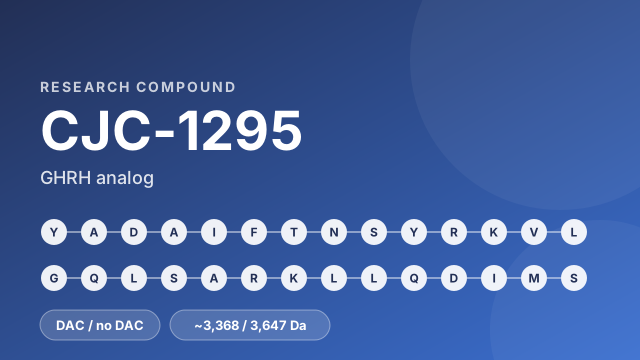
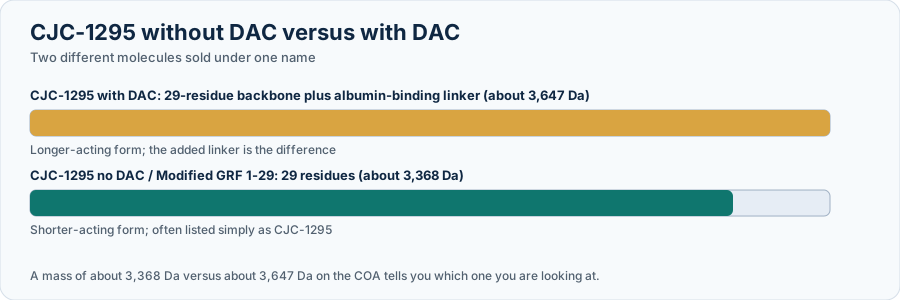
The first is CJC-1295 with DAC. DAC stands for drug affinity complex, a small chemical attachment designed to make the peptide latch onto albumin, the abundant carrier protein in blood. Because albumin circulates for weeks, a peptide hitched to it lasts far longer than a free one. The second is CJC-1295 without DAC, known in the literature as modified GRF(1-29) or tetrasubstituted GRF(1-29). It is the same 29-residue backbone without the albumin hook. Many sellers call it simply "CJC-1295," and many buyers assume that is the whole story.
Where the molecule comes from
Growth hormone-releasing hormone, GHRH, is a 44-residue peptide, but its activity lives in the first 29 residues. Researchers worked out decades ago that the shortened fragment, GRF(1-29), keeps most of the biological activity. It is also fragile: enzymes snip it within minutes. Chemists responded by changing four amino acids in the chain, swapping in a D-alanine near the front and a few other substitutions at positions that enzymes attack. The result, modified GRF(1-29), weighs about 3,368 daltons and is substantially more durable than the natural fragment.
Canadian biotech company ConjuChem then took that molecule and added the DAC attachment, a lysine side chain carrying a maleimide group that reacts with albumin. This is CJC-1295 with DAC, mass about 3,647. In published pharmacokinetic work on healthy volunteers, the result was growth hormone and IGF-1 elevations lasting days rather than hours. The company's development program was later discontinued, and no CJC-1295 product holds regulatory approval.
So, the two forms differ in architecture and pharmacology. They are no more interchangeable than a short-acting and a long-acting version of any drug. Treating them as the same thing, in a lab or in a price comparison, is an error.
How to tell which one you are looking at
Product titles are the first clue, and the most unreliable. Look for explicit wording: "with DAC," "no DAC," "Mod GRF 1-29," or "tetrasubstituted GRF." Where a title says only "CJC-1295," look at the picture of the vial label, the product description, and above all the mass on the certificate of analysis.
| No DAC (Mod GRF 1-29) | 29 residues, amidated C-terminus. Mass about 3,368 Da. |
|---|---|
| With DAC | Same backbone plus a lysine-linked maleimidopropionyl group. Mass about 3,647 Da. |
| Mass difference | About 279 Da. Easy to see on a mass spectrum, impossible to see on a purity percentage. |
| Common mislabel | A no-DAC product listed as plain CJC-1295, or a COA from one form attached to the other. |
A COA that gives HPLC purity but no mass cannot settle the question at all. One that shows a mass of about 3,368 for a product titled "with DAC" is an obvious red flag, and one showing about 3,647 for a product described as no-DAC is just as bad. Both errors happen, sometimes through carelessness and sometimes because cheaper material is substituted.
A 29-residue peptide is still a demanding synthesis
At around 3,400 daltons, modified GRF(1-29) is much larger than ipamorelin or BPC-157, and the same compounding-error arithmetic that plagues tesamorelin applies in lesser form. Deletion sequences and truncated chains are the typical contaminants, and they run close to the main peak. Like any peptide of this length, it can also degrade slowly through oxidation or deamidation if stored badly. A full chromatogram with minor peaks visible is worth far more than a headline percentage.
The DAC version adds a further manufacturing step, the attachment of the linker, and a further failure mode, in which the reactive maleimide group degrades or binds to something it should not. If a supplier sells the DAC form at the same price as the no-DAC form, ask why.
Why the pharmacology story gets garbled online
Most of what is said about CJC-1295 on forums merges two different bodies of evidence. The published human pharmacokinetic study used the DAC form, and showed a long-lasting rise in hormone levels after a single exposure. The no-DAC form, which most of the retail market sells, behaves like a short-acting GHRH analog, with an action measured in hours. Claims made from one set of data are routinely attached to the other product. For a buyer this is not an abstract point: if you read a paper about the DAC molecule and then purchase the no-DAC one, nothing in the paper describes what you have. The same caution applies to anything you read in a listing description. Treat product pages as marketing, treat COAs as evidence, and where the two disagree, believe the COA. If there is no COA for the batch, then you have only marketing, and that is worth knowing before you buy rather than after.
It is also worth remembering that the human data are small. The principal published study involved several dozen healthy adults, was funded by the developer, and tested the DAC product in a controlled clinical setting with pharmaceutical-grade material. None of that carries over to research-grade powder.
Blends and combinations
CJC-1295 appears constantly in blends, most often with ipamorelin. The labels on these products tend to read "CJC-1295 + ipamorelin" without saying which CJC. Because the combination is popular, it is also the place where mislabelling is easiest. A good COA for a blend identifies each component separately, with its own mass, and states the quantity of each. Without that, you cannot say what is in the vial. Note the arrangement at one of the suppliers below: Vortex offers CJC-1295 without DAC only in combination with ipamorelin, and does not list it separately.
Regulatory and sport context
CJC-1295 is not an approved drug anywhere, and it is on the World Anti-Doping Agency's list of prohibited substances, as are other growth hormone-releasing factors. This page treats it strictly as a research material.
Where to find it
Three suppliers in our directory list a CJC-1295 product. I have not ordered from any of them for this page. Pay attention to which form each one sells.
Iron Peptides lists a 10 mg CJC-1295 vial; check the product page for whether it specifies DAC. Code IRONMAN gives 10% off. See our Iron Peptides review; the company is a sponsored listing here.
Next Gen Peps lists CJC-1295 No DAC (Mod GRF 1-29) as its own product, and separately lists a with-DAC version under a different handle. The link here goes to the no-DAC page. See our Next Gen Peps review.
Vortex Research sells CJC-1295 no DAC only as a blend with ipamorelin, and the link here goes to that blend. Its PEPPERS code is advertised at 30% off. Not yet reviewed on this site.
These are affiliate links. PeptideSuppliers.org may earn a commission if you buy, at no cost to you. This does not affect ratings, and the suppliers are listed alphabetically, not by preference. Read the disclosure for details.
Short answers
Which form is cheaper?
Usually no-DAC, because it is shorter and easier to make. A with-DAC product priced like a no-DAC one deserves a closer look at the COA.
Does DAC change the peptide's sequence?
The backbone is the same; the DAC adds a chemical group to a lysine side chain. The change is visible in the mass.
Is "Mod GRF 1-29" the same as CJC-1295 no DAC?
Yes, they are two names for the same molecule, which is a source of the confusion.
For all suppliers we track, see the supplier database.
For laboratory research use only. Not medical advice; no claims about safety, legality or fitness for any use. See the medical disclaimer.