
Research-use-only guide. It explains what SS-31 is and how to read supplier documentation. It offers no dosing, administration or health advice. Supplier links are affiliate links; see below.
Two names, one tetrapeptide, one very different status
SS-31 is the research name of a four-amino-acid peptide that has also been known as Bendavia, MTP-131 and, in its pharmaceutical development, elamipretide. The name SS-31 comes from its inventors' compound series, the Szeto-Schiller peptides, named for Hazel Szeto and Peter Schiller, who designed them in the early 2000s. Szeto worked at Weill Cornell Medical College in New York; the compound was developed commercially by Stealth BioTherapeutics.
This history makes SS-31 unusual in this directory. In September 2025, the US Food and Drug Administration granted accelerated approval to elamipretide, sold as Forzinity, for Barth syndrome, a rare inherited mitochondrial disease. The approval covers patients weighing at least 30 kilograms and rests on a surrogate endpoint, knee-extensor muscle strength, with a confirmatory trial required. It is a prescription medicine made under pharmaceutical controls and given by injection under medical supervision. That regulatory fact is the most important piece of context on this page, and it comes with an equally important caution: it does not transfer to research-grade powder sold by a laboratory supplier. The approved product has its own manufacturing standards, sterility testing and labelling. A vial of research peptide has none of them, and this site gives no guidance on use.
A peptide that does not look like a peptide
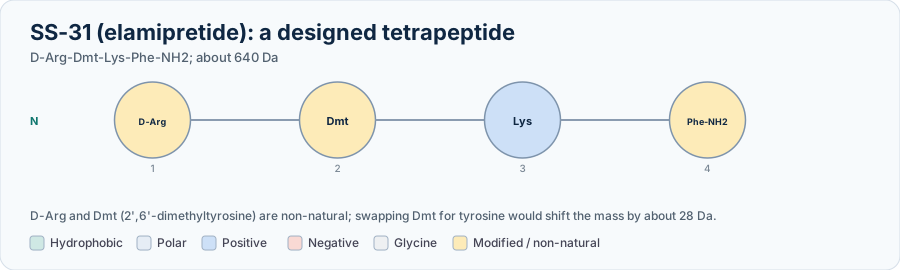
Written out, the structure is D-Arg-Dmt-Lys-Phe-NH2. Each piece is chosen deliberately. D-arginine is the mirror-image form of the natural amino acid, which resists enzymes that normally dismantle peptides. Dmt stands for 2',6'-dimethyltyrosine, a tyrosine with two extra methyl groups on its ring, which is a non-natural residue and is both an antioxidant motif and a stability booster. Lysine is a natural residue and Phe-NH2 is phenylalanine capped with an amide. Two of the four residues carry a positive charge at body pH, giving the whole molecule a net charge of about plus three. The mass is about 640 daltons.
The design principle is unusual: positively charged, aromatic peptides of this type cross cell membranes without a transporter, and then concentrate in the inner mitochondrial membrane by binding to a phospholipid called cardiolipin that is found almost exclusively there. In experiments, binding to cardiolipin is proposed to stabilise the arrangement of respiratory chain components. This mechanism is based on laboratory studies and remains the subject of active debate, but it explains why SS-31 is described as a mitochondria-targeted compound.
What the clinical history shows, and does not show
Elamipretide has been tested in people more than almost any other compound in this directory. Trials have examined it in primary mitochondrial myopathy, where one large study did not meet its primary endpoint; in age-related macular degeneration; and in Barth syndrome, where the data eventually supported the accelerated approval. That mixed record is the honest picture. A compound with a coherent mechanism and a regulatory approval for one rare disease has also had trial results that did not meet their goals in other conditions. Reading about it uncritically, in either direction, is a mistake.
Preclinical work covers heart failure models, kidney injury, age-related muscle decline in mice and more. These are suggestive studies, not evidence about effects in people who obtain research-grade material. We therefore describe the literature without implying outcomes.
Why structure confirmation matters more than usual
For a plain peptide, matching the mass is nearly proof of identity. SS-31 weakens that logic in two ways. First, it contains a D-amino acid, and a molecule with L-arginine in place of D-arginine has exactly the same mass but a different three-dimensional shape and different stability. Second, Dmt is a non-natural residue that a careless manufacturer might replace with ordinary tyrosine, the cheaper and more available option. The mass difference is about 28 daltons, easily seen on a spectrum, but only if somebody looks. A supplier using the wrong building block would produce something that resembles SS-31 but is not.
| Expected mass | About 640 Da for the free base (D-Arg-Dmt-Lys-Phe-NH2). With ordinary tyrosine instead of Dmt it would be about 612. |
|---|---|
| Chirality | Mass cannot reveal it. A chromatogram with a clean single peak, ideally with a stated chiral method or reference, is the evidence. |
| Chromatogram | Full trace. A four-residue peptide should give a dominant peak; flanking peaks deserve explanation. |
| Counter-ion | Acetate or TFA. With three positive charges, up to three counter-ions can be present, so net content can be well below label weight. |
| Name on the COA | The report should identify the compound as SS-31 or elamipretide and state its structure, not only a code. |
| Batch details | Lot, test date and laboratory, matching the vial. |
Reading the literature with the right label
A practical hazard for anyone researching this compound is that the same molecule appears under several names, and the evidence attached to each name differs. Papers from the academic laboratories mostly say SS-31. Clinical papers and company documents say elamipretide, MTP-131 or Bendavia. Retail listings say SS-31, elamipretide, or sometimes just "SS31". Searching under only one name will miss most of the record. It is also worth checking, in any paper, whether the study used a research-grade peptide made in the investigators' own laboratory or the clinical drug product supplied by the developer, because those are different materials with different documentation. When a vendor cites clinical results to market a research vial, ask whether those results came from pharmaceutical-grade supply. They almost always did. That gap, between the evidence base and the thing for sale, is the single most important thing to keep in mind with this compound.
The patent and the supply question
Because elamipretide is a branded drug with an active commercial owner, the legal position of selling the same molecule as a research chemical is not a topic this page can settle, and I have not verified the current patent landscape. What is clear is that the pharmaceutical supply chain and the research-chemical supply chain are separate. Anyone who asserts that a research vial is identical to, or interchangeable with, the approved product is making a claim nobody can support from a certificate of analysis.
Where it fits with other mitochondrial topics
SS-31 is often mentioned alongside MOTS-c and NAD+ in discussions of mitochondrial biology. They share a theme, not a mechanism. MOTS-c is a natural peptide encoded in mitochondrial DNA, NAD+ is a coenzyme, and SS-31 is a designed tetrapeptide that binds a mitochondrial lipid. Each needs different quality checks.
Where to find it
Three suppliers in our directory list SS-31. I have not ordered from any for this page; the notes reflect public listings.
Iron Peptides lists SS-31. Code IRONMAN gives 10% off. See our Iron Peptides review; the company is also a sponsored listing on this site.
Next Gen Peps lists SS-31 (Elamipretide) in its catalog. See our Next Gen Peps review.
Vortex Research lists SS-31 and advertises the PEPPERS code at 30% off. It has not been reviewed on this site yet.
All three are affiliate links. PeptideSuppliers.org may earn a commission if you buy, at no extra cost to you. This does not influence our ratings, and the suppliers are listed alphabetically. See the disclosure page.
Short answers
Is SS-31 the same as Forzinity?
It is the same molecule as elamipretide, the active ingredient. A research vial is not the approved product, which is made and controlled differently.
Why does the D-amino acid matter?
It changes how the molecule resists enzymes and folds, and the mass cannot reveal an error. Chromatography is the better check.
Why would a supplier substitute tyrosine for Dmt?
Dmt is more expensive and less common. A mass near 612 instead of 640 would reveal the substitution.
For all suppliers we track, see the supplier database.
For laboratory research use only. Not medical advice; no claims about safety, legality or fitness for any use. See the medical disclaimer.