PS PeptideSuppliers.org Finding the right peptide supplier for you
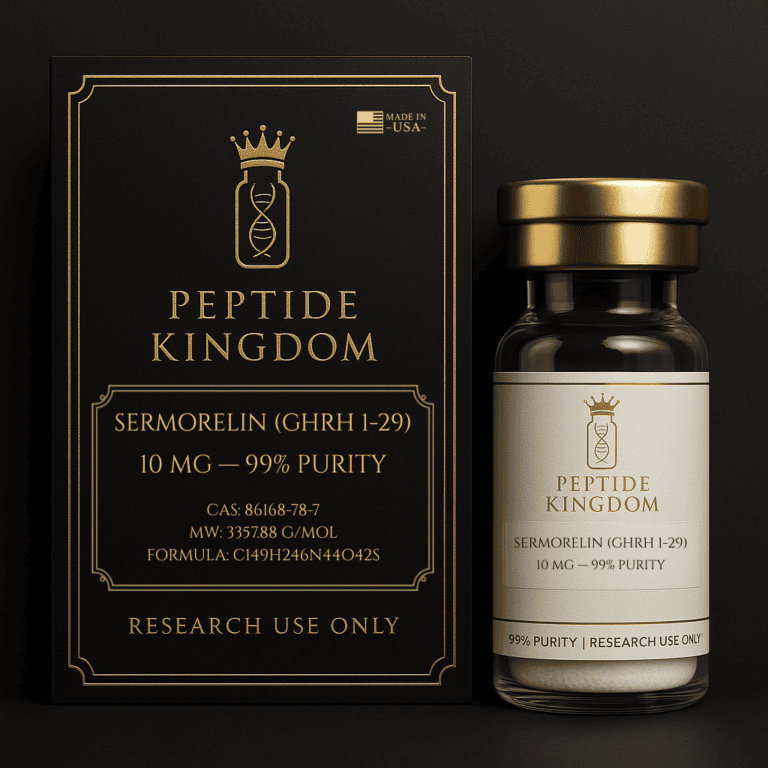
Sermorelin reference image
Peptide guide

Sermorelin Peptide Guide & Supplier Listing Notes

GHRH analog

GHRH analog / GH-axis research

Growth hormone secretagogue research compounds Educational guide Supplier transparency

Research Areas

The main research domains where this compound appears most often.

Sermorelin is most strongly connected to growth hormone reserve and endocrine testing. Because it stimulates pituitary GH release, it has been used to evaluate whether the pituitary can respond to GHRH stimulation.

A second research area is aging-related endocrine function. Some studies have examined whether GHRH analogs can activate the somatotropic axis in older adults. This connects sermorelin to broader questions about GH, IGF-1, body composition, immune markers, and age-related physiology.

Sermorelin is also important as a comparison compound. Readers often compare sermorelin with tesamorelin, CJC-1295, and ipamorelin. those differences clearly instead of grouping every GH-axis peptide together.

Animal studies

What preclinical work has emphasized

Preclinical research with GHRH analogs helps explain pituitary receptor signaling, growth hormone pulsatility, and downstream IGF-1 effects. Animal models can clarify receptor biology and endocrine feedback, but sermorelin's most useful identity comes from its role in human endocrine testing and GH-axis research.

Animal findings should therefore be treated as mechanistic background rather than the main evidence base for sermorelin. The central point is that GHRH receptor activation can stimulate endogenous GH release when the pituitary is responsive.

Human studies

How much human evidence exists

Sermorelin has human research related to growth hormone deficiency evaluation and endocrine stimulation testing. Reviews describe it as a GHRH analog suitable for provoking growth hormone release as part of diagnostic assessment.

Other human research has examined GHRH analogs in older adults and reported activation of the somatotropic axis. These studies help explain why sermorelin remains common in age-related peptide discussions, but they should not be overstated as proof of broad anti-aging outcomes.

Current research status

Where the research stands now

Sermorelin is best understood as an established GHRH analog with historical use in endocrine evaluation and continuing relevance in peptide education. Its research importance comes from clarifying how the GHRH pathway stimulates endogenous growth hormone release.

Current interest is mostly educational, comparative, and endocrine-focused. It is often used as a reference point for explaining newer or longer-acting GH-axis compounds.

Related Compounds

Closely related compounds frequently discussed within the same research category.

Tesamorelin and CJC-1295 are the closest related GHRH analogs. Ipamorelin is related through GH release but uses a different receptor pathway. IGF-1 LR3 is related downstream through IGF-1 signaling. Growth hormone is related biologically, but it is not the same type of compound.

Supplier considerations

How to read supplier pages more carefully

Sermorelin listings should clearly identify the peptide as GHRH(1-29) or sermorelin and should include batch-specific COAs. Because it is often grouped with other GH-axis compounds, clear labeling matters. Researchers should look for third-party testing, purity data, lot numbers, storage guidance, and research-use disclaimers.

  • Look for batch-specific COAs instead of generic laboratory files reused across many listings.
  • Check whether the product name, concentration language, and batch references stay consistent from page to page.
  • Read storage and handling notes alongside the document links rather than treating the headline purity claim as enough.
  • Prefer supplier pages that keep research-use labeling, contact details, and policy pages easy to verify.

Linked supplier pages

Supplier pages that help compare naming, documentation access, batch references, and overall page clarity.

Supplier listing

Peptides Kingdom

This listing helps with checking naming, documentation access, storage language, and overall page clarity.

15% off with code KING15

Frequently Asked Questions

Common questions drawn from the published literature and documentation context.

What is sermorelin?

Sermorelin is a synthetic GHRH(1-29) analog that stimulates growth hormone release from the pituitary gland.

Is sermorelin growth hormone?

No. Sermorelin stimulates endogenous growth hormone release; it is not growth hormone itself.

How is sermorelin different from tesamorelin?

Both are GHRH-related, but tesamorelin has stronger clinical research in HIV-associated visceral adiposity.

How is sermorelin different from ipamorelin?

Sermorelin acts through GHRH receptors, while ipamorelin acts through the ghrelin receptor.

What is sermorelin studied for?

It is studied in GH reserve, pituitary responsiveness, GH/IGF-1 axis research, and age-related endocrine function.

Does sermorelin have human research?

Yes. Sermorelin has human endocrine literature, including diagnostic and stimulation studies.

What compounds are related to sermorelin?

Tesamorelin, CJC-1295, ipamorelin, growth hormone, and IGF-1 LR3 are closely related.

What should researchers check when reviewing sermorelin suppliers?

COAs, purity data, peptide identity, storage instructions, and batch-specific documentation.

References

Primary sources and clinical references cited in this overview.